


ISSUE1757


- Jean-Marie Pflomm, Pharm.D., Editor in Chief has disclosed no relevant financial relationships.
- Amy Faucard, MLS, Associate Editor has disclosed no relevant financial relationships.
- Review the efficacy and safety of dupilumab (Dupixent) for treatment of allergic fungal rhinosinusitis.
Dupilumab (Dupixent – Sanofi/Regeneron), a subcutaneously injected interleukin (IL)-4 receptor alpha antagonist that is FDA-approved for several indications, including treatment of chronic rhinosinusitis with nasal polyps, has now been approved for treatment of allergic fungal rhinosinusitis (AFRS) in patients ≥6 years old who previously had sinonasal surgery.1-3 It is the first drug to be approved in the US for this indication.
THE DISORDER — AFRS is a subtype of chronic rhinosinusitis with nasal polyps that is characterized by an inflammatory response to noninvasive fungi and accumulation of eosinophilic mucin. Symptoms include nasal polyps, nasal congestion or obstruction, loss of smell, and postnasal drainage. Moderate to severe AFRS can lead to bony erosion of sinus walls and orbital expansion. Most cases occur in places with warm, humid climates such as the southern US.4
STANDARD TREATMENT — Endoscopic sinus surgery is often recommended initially to remove nasal polyps and inflammatory mucin. Disease recurrence is common; about 30% of patients require revision surgery. Postoperative treatment with oral and/or topical corticosteroids is recommended to reduce or delay recurrence. Antifungal therapy and immunotherapy have been tried, but high-quality evidence supporting their efficacy is lacking. Omalizumab (Xolair, Omlyclo) and mepolizumab (Nucala), biologic drugs that are approved for treatment of chronic rhinosinusitis with nasal polyps, are under investigation for treatment of AFRS.5
MECHANISM OF ACTION — Dupilumab is a human IgG4 antibody that binds to the IL-4 receptor alpha subunit shared by IL-4 and IL-13. It inhibits the signaling of these cytokines, which are thought to play a role in the inflammatory pathophysiology of AFRS.
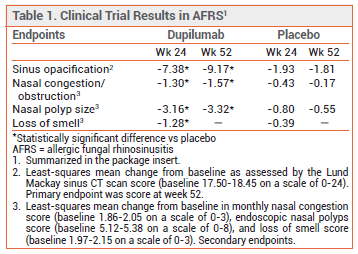
CLINICAL STUDIES — FDA approval of dupilumab for the new indication was based on the results of an unpublished randomized double-blind trial (Liberty-AFRS-AIMS; summarized in the package insert) in 62 patients ≥6 years old with AFRS, 61 of whom had a history of ≥1 sinonasal surgery. Patients received dupilumab (dosage based on age and body weight) or placebo for 52 weeks. Dupilumab significantly reduced sinus opacification, nasal congestion/obstruction, and nasal polyp size compared to placebo at week 52 (see Table 1). Patients receiving dupilumab were less likely to require oral corticosteroids (3% vs 31% with placebo) and/or sinonasal surgery (0% vs 6.9%). The proportion of patients with bone erosion in sinuses on CT scan was comparable in the dupilumab and placebo groups at baseline, but was lower in the dupilumab group at week 52.
In a retrospective cohort study, patients with presumed AFRS who were treated with dupilumab, omalizumab, or mepolizumab were compared to matched controls. Only dupilumab reduced the risk of all clinical outcomes, including sinus surgery, inpatient admission, emergency department visits, and acute sinusitis.6
ADVERSE EFFECTS — Adverse effects of dupilumab in patients with rhinosinusitis have included injection-site reactions, conjunctivitis, insomnia, gastritis, arthralgia, and toothache. Hypersensitivity reactions, including anaphylaxis, and an increase in blood eosinophil counts have been reported.
DRUG INTERACTIONS — Use of live vaccines should be avoided in patients receiving dupilumab.
DOSAGE, ADMINISTRATION, AND COST — The recommended dosage of dupilumab for treatment of AFRS in adults is 300 mg once every 2 weeks; in patients 6-17 years old, the dosage is based on weight: 300 mg every 4 weeks (15-<30 kg), 200 mg every 2 weeks (30-<60 kg), or 300 mg every 2 weeks (≥60 kg). Dupilumab should be injected subcutaneously into the thigh, abdomen, or upper arm; patients or caregivers can be trained to administer the drug at home. A single 300-mg dose of Dupixent costs about $2000.7
CONCLUSION — The injectable interleukin (IL)-4 receptor alpha antagonist dupilumab (Dupixent) is the first drug to be approved in the US for treatment of allergic fungal rhinosinusitis (AFRS). In one clinical trial in patients with AFRS who had undergone sinonasal surgery, dupilumab was more effective than placebo in reducing sinonasal symptoms and the need for oral corticosteroids and/or sinonasal surgery for up to 52 weeks.
- Dupilumab (Dupixent) for eosinophilic esophagitis and prurigo nodularis. Med Lett Drugs Ther 2023; 65:18.
- Dupilumab (Dupixent) for COPD. Med Lett Drugs Ther 2025; 67:11.
- In brief: Dupilumab (Dupixent) for chronic spontaneous urticaria. Med Lett Drugs Ther 2025; 67:111.
- AU Luong et al. Allergic fungal rhinosinusitis: the role and expectations of biologics. J Allergy Clin Immunol Pract 2022; 10:3156. doi:10.1016/j.jaip.2022.08.021
- MW Liu et al. Allergic fungal rhinosinusitis: a contemporary update. Ear Nose Throat J 2025 Jun 9 (epub). doi:10.1177/01455613251346578
- MA Bentan et al. Impact of biologics on surgery in chronic rhinosinusitis with polyps and allergic fungal sinusitis. Laryngoscope 2025; 135:593. doi:10.1002/lary.31774
- Approximate WAC. WAC = wholesaler acquisition cost or manufacturer's published price to wholesalers; WAC represents a published catalogue or list price and may not represent an actual transactional price. Source: AnalySource® Monthly. May 5, 2026. Reprinted with permission by First Databank, Inc. All rights reserved. 2026. www.fdbhealth.com/drug-pricing-policy.

 Previous article